
If you are choosing multi tenant PBX software to resell hosted phone service, ICTPBX Service Provider Edition and MiRTA PBX will both end up on your shortlist. They serve the same buyer. They do not have the same shape, and the difference decides what you can put on a customer invoice.
Short version: MiRTA is a management layer over Asterisk that scales voice well. ICTPBX EE is a platform over FreeSWITCH where voice, fax, SMS and an AI agent are separately rated services inside one tenant. If you sell voice, MiRTA is a serious option. If you sell more than voice, the comparison stops being close.
The structural difference
MiRTA runs a PHP panel over a MySQL database, and a pool of Asterisk nodes reads its configuration from that database at call time. There is no apply step, and several nodes can share one configuration set. For scaling voice that is a genuinely good design, and I would not pretend otherwise.
ICTPBX EE splits the control plane from the media plane. A REST API sits in front, FreeSWITCH 1.10.12 handles media and signalling underneath, and FusionPBX 6.6.0 acts as the voice configuration store, so PBX behaviour rests on software already deployed at scale rather than on something we reinvented. The services in between are where fax, SMS, AI and billing live, and the Angular portal is just the API’s first client. Platform and billing data sit in MariaDB, voice configuration in PostgreSQL.
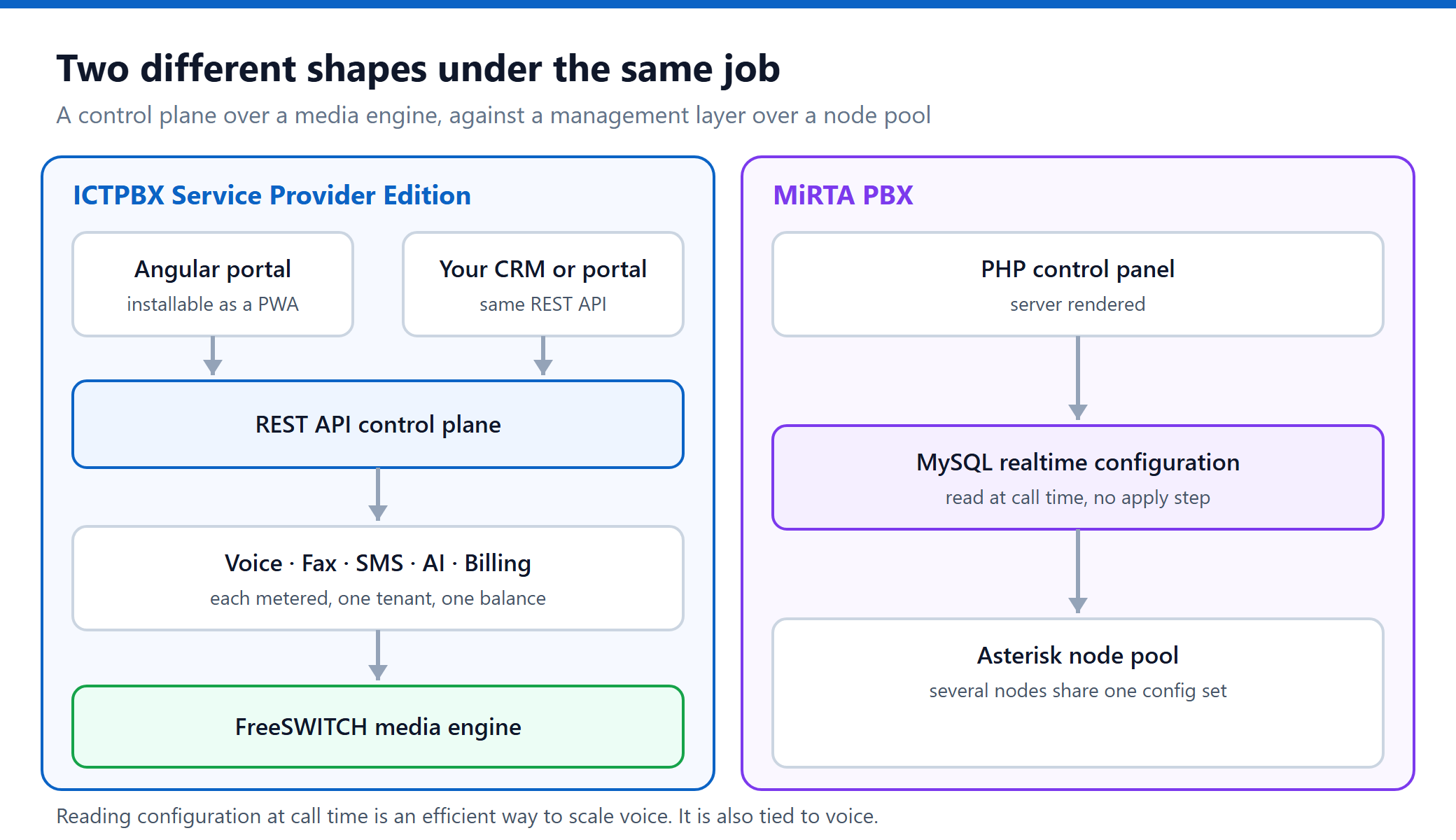
A control plane over a media engine, against a management layer over a node pool.
That API point matters more than it sounds. Anything the portal can do, your own ordering system can do over the same authenticated interface: create a tenant, add extensions, assign a DID, send a fax, pull usage. If you already run a CRM, phone service becomes another product inside it instead of a second place to retype customer data. The REST API reference covers the objects.
Multi tenancy: both isolate, one goes deeper
Both products put many customers inside one installation with separate configuration and permissions. ICTPBX carries the isolation further down the stack, giving each tenant its own voice domain so extension numbers belong to the tenant rather than a shared namespace. Two customers can both use extension 1001 and never collide.
Branding is the other gap. ICTPBX resolves branding from the hostname the customer opens, before login, so each tenant gets its own domain, logo, favicon, login background and colours, and you can lock the theme so the customer cannot change it. The portal also installs as an app, so their staff get a branded icon rather than a bookmark. MiRTA does hostname theming too, though without the app install.
On hierarchy the two are level, and I will be straight about it: neither offers tenants underneath tenants. If you need a true reseller tier, that is roadmap work here, not a shipped feature.
Everyday PBX features are close to a tie
Extensions, IVR menus, ring groups, queues, voicemail, conference bridges, time based routing, follow me, music on hold, call blocking, feature codes, recording, a browser softphone, phone provisioning, SIP trunks, DID routing and live call monitoring all appear on both sides. Anyone telling you one platform has twice the PBX features is selling something.
Where MiRTA is genuinely ahead on telephony is supervision. Pickup, spy, whisper and barge, plus parking lots and a full switchboard panel, ship there today and are planned here. If you run receptionist heavy accounts or contact centre style supervision from day one, that gap is real and you should weigh it.
MiRTA also offers Microsoft Teams direct routing, which ICTPBX does not, and GeoIP based fraud rules with per tenant call limits. ICTPBX blocks intrusion at the network layer and has credit and fraud controls, with per tenant destination rules on the roadmap.
This is where the products stop overlapping
Fax, SMS and AI are not conveniences bolted to the phone system in ICTPBX. They are metered services with their own tenant interfaces and their own line on the bill.
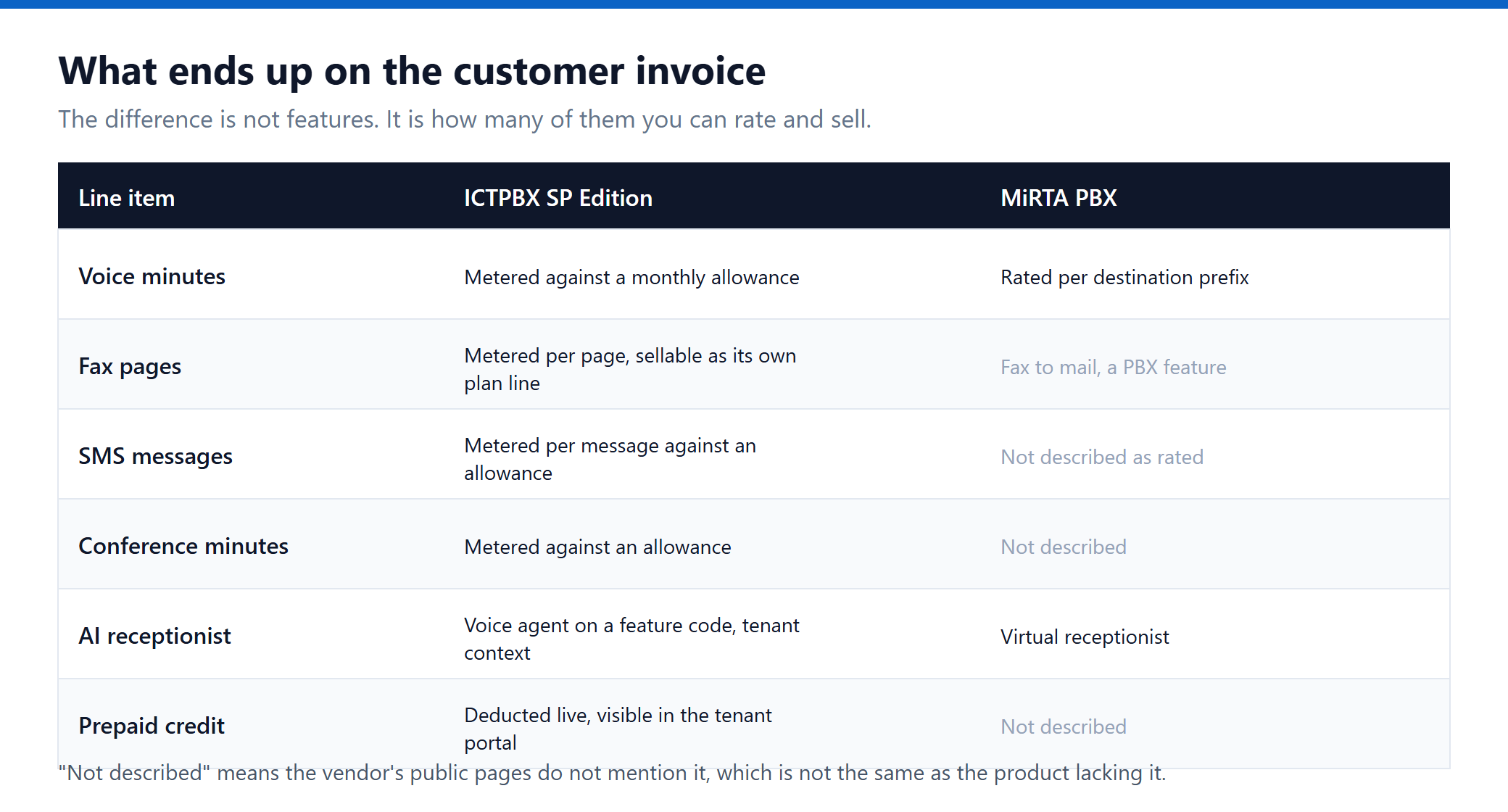
The difference is not the feature list. It is how much of it you can rate and sell.
Inbound fax routes at DID level and arrives as a PDF by email, with an inbox in the portal and live delivery events. Outbound sends from the portal with cover pages, a document library, delivery status and retry, and there is broadcast fax to contact lists. Every page is metered against a monthly allowance. MiRTA offers fax to mail and mail to fax as PBX features.
That matters commercially more than people expect. Fax is still a live revenue line in healthcare, legal, logistics and government, and a general purpose PBX panel rarely goes past fax to mail. SMS gets the same treatment rather than being an afterthought. Two way messaging with a tenant inbox, inbound delivery straight into the portal and outbound campaigns, metered per message against a monthly allowance and prepaid credit, so it is sellable as its own plan line. On the MiRTA side SMS appears as a campaign workflow rather than a rated service.
On AI the honesty runs the other way. MiRTA ships call transcription with speaker labels, call summaries and sentiment scoring today. ICTPBX ships a conversational AI voice agent reachable on a feature code that answers in the tenant’s own context, and call analytics is roadmap. Those are different products solving different problems, and if analytics is what you need, MiRTA has it now.
Billing is the part providers underestimate
ICTPBX includes a working commercial engine. You define packages that set what a tenant may have, extensions, devices, queues, IVRs, voicemail boxes, conference rooms, and what they get included monthly across voice minutes, fax pages, conference minutes and SMS. Limits are enforced at creation time, so a customer on a ten extension plan cannot quietly create an eleventh.
Usage meters continuously. Included units go first, and only overage draws down prepaid credit at your configured rate. Allowances reset with the billing month, and the tenant sees remaining allowance and credit update live in their own portal rather than after an overnight batch.
Neither product is a full telecom billing suite. Invoices, tax and card processing live in an accounting system either way. The difference is the starting point. ICTPBX lets you sell packaged plans with allowances and prepaid credit on day one. MiRTA’s per prefix rating, priced per tenant or even per extension, is the better fit if your actual product is minutes to many destinations.
Deployment and what it costs
ICTPBX installs with a single command that brings up the telephony engine, databases, web server, portal and TLS, including secure WebRTC. Re-running the installer detects the existing deployment and offers keep, upgrade or abort. It runs on Enterprise Linux 8 and 9.
The honest limitation: ICTPBX runs on a single node today, with multi node on the roadmap. MiRTA can spread call processing across several licensed nodes. For most hosted PBX businesses one properly sized server carries the tenant counts involved, but if you are planning for very high concurrency you should raise it with us early. Worth noting MiRTA’s own documentation says its clustering does not preserve calls in progress when a node fails, so the benefit there is capacity and faster recovery rather than true failover.
MiRTA publishes one list price, 200 euro per licensed server per month with no per tenant or per extension fee, and terms apply. Cost follows capacity rather than customer count, and the software is closed and licence key activated.
ICTPBX comes in two editions of one codebase. The Community Edition is free and public, single tenant, without billing and branding, running the same telephony core so you can evaluate before spending anything. The Service Provider Edition is the multi tenant platform described here, quoted per deployment.
The comparison worth running is not the licence line alone. A voice only platform still needs a fax service, a messaging provider and a rating system beside it, each with its own subscription and integration work.
So which one should you pick
Pick MiRTA if your product is voice at high concurrency, you price minutes per destination prefix, you need supervision and parking on day one, Teams direct routing is a requirement, or you need AI transcription and sentiment scoring now.
Pick ICTPBX if your offer is more than voice, if fax carries commercial weight for your customers, if you want to sell packaged plans with allowances and prepaid credit without bolting on a billing system, if tenant provisioning needs to run from your own CRM over an API, or if the portal has to look like your product down to the domain and app icon.
If you are unsure, install the Community Edition. It costs nothing and it answers more questions than any comparison table, including this one.
Frequently asked questions
Is ICTPBX built on Asterisk or FreeSWITCH?
FreeSWITCH handles media and signalling, covering SIP trunks, IP phones, WebRTC, conferencing, recording, T.38 fax and codecs including Opus for browser calls, with FusionPBX as the voice configuration store on top of it. MiRTA uses an Asterisk node pool. Both are mature open source switches and the choice rarely matters to your end customer, though it matters a great deal to whoever maintains the platform.
Can I try it before buying?
Yes. The Community Edition is free and public and runs the same telephony core, and there are demo logins for a running system if you would rather click around first.
Does ICTPBX support resellers selling to their own customers?
Not today. There are provider admins, tenant admins, end users and agents, but no tenant nested under another tenant. A reseller tier is planned. If that is a hard requirement now, say so before you buy.
What happens when a tenant runs out of credit?
Included monthly allowances are consumed first, and only usage beyond them draws down prepaid credit at your configured rate. The tenant watches the balance fall live in their own portal, so it is visible before it becomes a support call.
Is SMS actually shipping, or is it on the roadmap?
Shipping, in the Service Provider Edition. Tenants get a messaging inbox, inbound messages land in the portal, and outbound campaigns go out from the same place. Every message is metered against the monthly allowance and then against prepaid credit, so you can price it as a plan line instead of giving it away with the phone system. Email is the one channel we do not offer.
How were the MiRTA details in this comparison sourced?
From the vendor’s own public pages, read on 17 September 2026, quoted or paraphrased rather than tested in a lab. Where their material does not state a capability we have written that it is not described rather than claiming it is missing, because absence from a website is not proof of absence from a product. Anything that matters to your decision is worth confirming with them directly.
Related resources
- Full ICTPBX feature list
- ICTPBX REST API
- Getting started with ICTPBX
- Fraud and credit controls
- Zero touch phone provisioning
Want the multi tenant platform with fax, SMS and AI on one tenant and one balance? See ICTPBX plans and pricing, or start free with the Community Edition and upgrade when the customer count justifies it.