
If your building still has copper pairs coming into it, the amount of warning you are guaranteed before they stop working is 90 days. That is the end user notice period, and after the FCC’s March 2026 order it is close to the only procedural step left. Anyone responsible for choosing PBX software should treat that number as the planning constraint, because a 90-day notice and a 90-day migration are not the same thing.
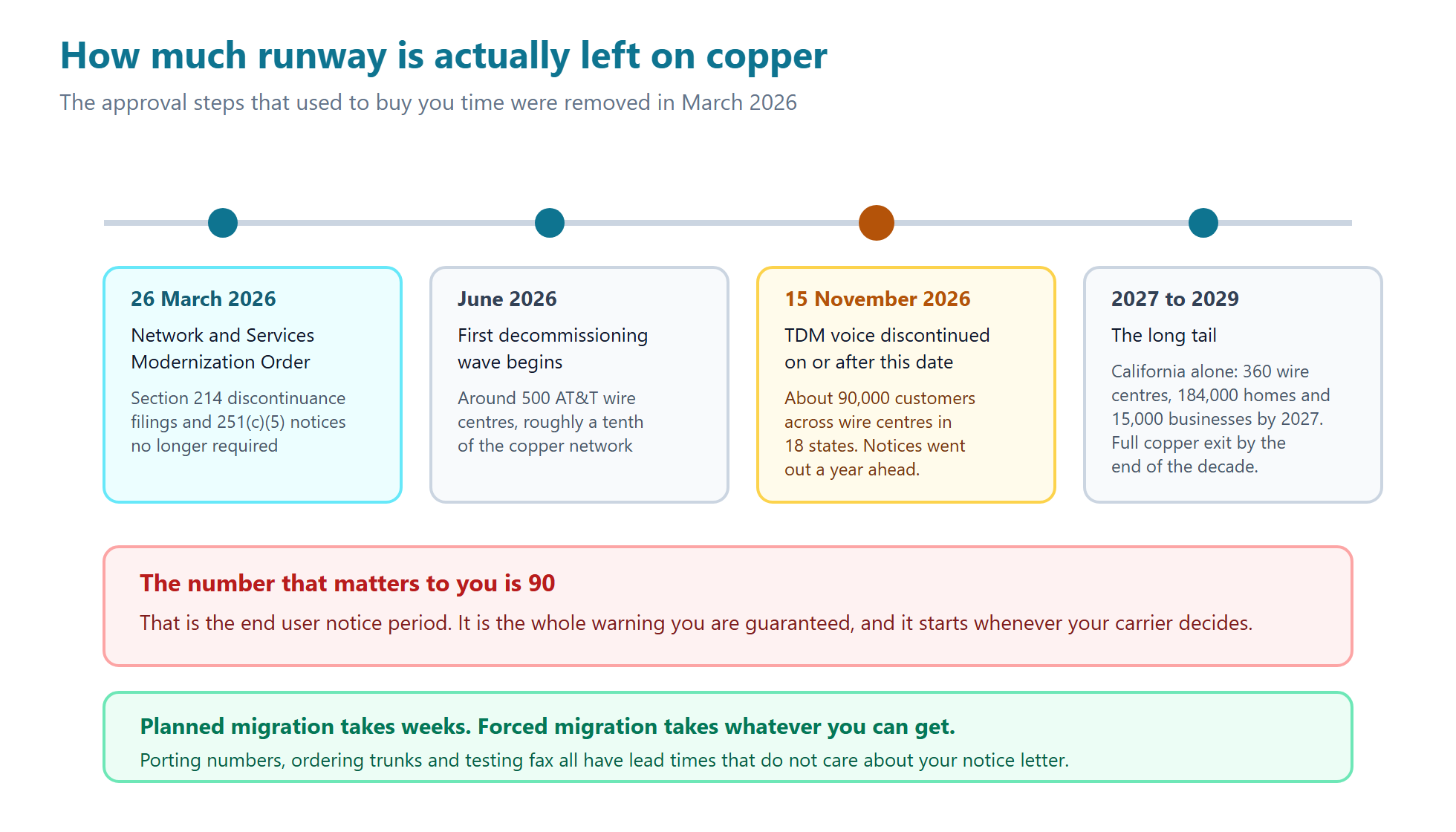
This is not a distant regulatory story. AT&T has asked to discontinue legacy TDM voice service on or after 15 November 2026, covering roughly 90,000 customers across parts of wire centres in 18 states. Decommissioning work started in around 500 wire centres in June 2026, about a tenth of the network.
What the FCC changed in March
On 26 March 2026 the Commission adopted the Network and Services Modernization Order, and it removed two federal checkpoints that used to sit between a carrier and a copper shutdown.
The first was the Section 214 discontinuance application, the filing a carrier had to make before dropping a service. The second was the Section 251(c)(5) network change disclosure. Between them, those two steps could add months, sometimes years, to a retirement, and they were the reason many businesses assumed copper would outlast their interest in the question.
Both are gone. The 90-day end user notice remains, and that is now doing most of the work that a much longer process used to do.
My read is that the order did not change the destination, only the speed. Copper was always going. What it removed was the slack that let people postpone the decision indefinitely, and a lot of buildings were relying on that slack without ever deciding to.
The dates worth writing down
November 2026 is the near one. AT&T’s 18-state discontinuance sent notices in November 2025 for a 15 November 2026 shutoff, so those customers got close to a year. That was generous by the standards of what the rules now require, and it is not a promise about the next wave.
California shows the scale of the long tail: 360 wire centres, roughly 184,000 residential lines and 15,000 businesses, with a 2027 deadline. Nationally, AT&T has said it intends to be out of copper by the end of the decade, with most of the movement falling between 2026 and 2029.
The uncomfortable part is that none of this tells you your date. Retirement is happening wire centre by wire centre. Two offices of the same company in the same state can be years apart. The only way to know is to ask your carrier which wire centre serves each site and whether it is scheduled, and it is worth doing that in writing.
Ninety days is not a migration plan
Here is why the notice period matters more than the shutdown date.
Number porting has its own timeline and it does not compress because you are in a hurry. A clean port of a handful of numbers can move quickly. A port involving a main published number, a block of DIDs, a mismatch between your billing name and the carrier’s records, or a disputed account balance can stall for weeks while people email each other. Losing a main number that has been on your letterhead for fifteen years is a marketing problem long after it stops being a telecoms one.
SIP trunk provisioning adds its own lead time, and then there is the part everyone underestimates, which is testing. Voice usually works on the first try. Fax does not always. Alarm and lift lines are somebody else’s product entirely.
Do this on your own schedule and it is a few weeks of unremarkable project work. Do it on a notice letter and you are making procurement decisions in a fortnight, which is how buildings end up on whatever their carrier happened to be selling.
Walk the building before you price anything
Almost every copper migration that runs late runs late for the same reason. Somebody counted the desk phones, priced the replacement, and then discovered the other things quietly living on those pairs.
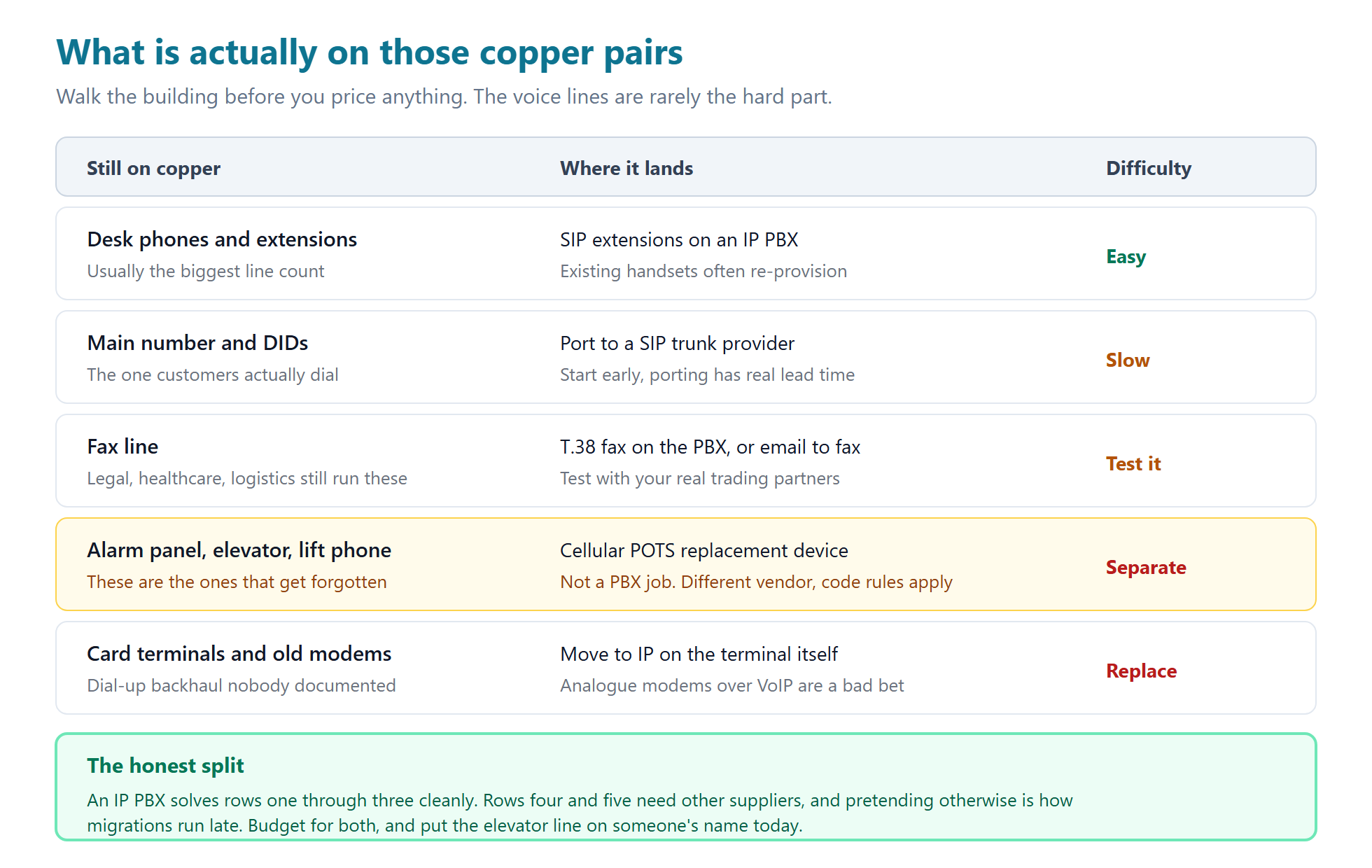
Extensions are the easy part. Most existing SIP handsets re-provision onto a new platform without being replaced, and even older analogue phones can hang on through an ATA if you are staging the work.
Your main number and DIDs are the slow part, so start there rather than finishing there. Port first, migrate the phones second.
Fax deserves its own paragraph because it keeps being written off as legacy and it keeps not going away. Legal, healthcare and logistics still run on it. The good news is that fax over IP is a solved problem when it is done properly: ICTPBX receives inbound faxes through the FreeSWITCH T.38 and G.711 stack, converts them to PDF and delivers them, with no separate fax server involved. The caveat is that T.38 behaviour varies between carriers, so test against the partners you actually exchange faxes with rather than a test service.
Then there are the lines nobody owns. Alarm panels, lift phones, card terminals, ancient modems backhauling something from a cupboard. An IP PBX does not solve these and you should be suspicious of anyone who says otherwise. Lift phones in particular are governed by building codes and generally need a cellular POTS replacement device from a different supplier. Put a name against each one this month, because these are the items that surface three days before a cutover.
What to look for in PBX software when the clock is running
Being rushed changes what matters in a platform, and it is worth being honest about which features are actually load-bearing under time pressure.
Provisioning speed matters more than feature depth. If every handset has to be configured by hand you have turned a weekend into a fortnight, so zero touch provisioning stops being a nice line on a datasheet and starts being the schedule. Trunk flexibility matters too, because the carrier you can get quickly may not be the carrier you would have chosen. Standard SIP and the ability to configure your own trunks keeps that door open.
Running both systems in parallel is the other thing to insist on. Point a test DID at the new platform, move one department, keep copper alive until the numbers have ported and the fax has passed a real transmission. A cutover with no overlap is a bet, and there is no reason to take it.
Where I would push back on the obvious answer is on hosted seats. The default advice when copper dies is to buy per-seat cloud voice, and for a 12-person office that is genuinely the right call. For a multi-site business, a managed service provider, or anyone who was already unhappy about per-seat pricing, a forced migration is an unusually good moment to change the model rather than repeat it on someone else’s platform. ICTPBX is multi-tenant and white label for that reason, and it ships in a free open source Community Edition alongside the Enterprise Edition, so evaluating it costs time rather than budget. If you are weighing it against the usual shortlist, our comparison with 3CX is a reasonable place to start, and what an IP PBX actually is covers the ground if this is your first migration.
What to do this quarter
Three things, none of which need a budget approved first.
Ask your carrier, in writing, which wire centre serves each of your sites and whether copper retirement is scheduled there. Keep the reply. Then walk every site and list what is on copper, including the things that are not phones. Finally, start the number port conversation before you have finished choosing a platform, because porting is the long pole and it is the one item that does not care how organised the rest of your project is.
Copper retirement is not an emergency for most businesses. It becomes one specifically for the businesses that were waiting for a deadline, and the FCC has just made the deadline arrive with 90 days of warning instead of two years.
Frequently asked questions
What did the FCC’s March 2026 order actually do?
The Network and Services Modernization Order, adopted 26 March 2026, removed the Section 214 discontinuance application and Section 251(c)(5) network change disclosure requirements for copper retirement. Carriers no longer need to clear those federal steps before retiring copper facilities. The 90-day end user notice requirement remains.
When exactly will my copper lines stop working?
There is no single national date. Retirement runs wire centre by wire centre. AT&T has sought to discontinue legacy TDM voice on or after 15 November 2026 for about 90,000 customers in parts of 18 states, with California scheduled around 2027 and full copper exit targeted by the end of the decade. Ask your carrier which wire centre serves your site.
Is 90 days enough time to migrate?
It is enough for a small single-site office with clean records. It is usually not enough once number porting, multi-site coordination and fax testing are involved, because porting delays are common and largely outside your control. Treat 90 days as the worst case you are planning against, not the plan.
Can I keep faxing after copper goes?
Yes. Fax over IP using T.38 handles this, and ICTPBX receives inbound faxes on a fax-type extension through the FreeSWITCH T.38 and G.711 stack and converts them to PDF. Test with the organisations you actually exchange faxes with, because carrier support for T.38 varies more than it should.
What about my alarm panel and lift phone?
Those need a cellular POTS replacement device and generally a specialist supplier, not a PBX. Lift phones are usually subject to building code requirements. Identify and assign these early, because they are the most commonly missed items in a copper migration.
Should I move to hosted seats or run my own PBX?
For a small single office, hosted per-seat voice is usually the pragmatic answer. For multi-site organisations, service providers and anyone reselling voice, owning the platform tends to work out better on both cost and control, and a forced migration is a sensible moment to reconsider rather than replicate the existing model.
Related resources
- What is an IP PBX?
- How to configure a SIP trunk
- Managing DID numbers
- Zero touch device provisioning
- Full ICTPBX feature list
Copper retirement details are drawn from the FCC’s Network and Services Modernization Order of 26 March 2026 and AT&T’s published discontinuance filings and customer notices.