
On Thursday 22 October 2026, AT&T and T-Mobile customers in Santa Barbara couldn’t reach 911 by voice from 8:15 a.m. to 4:35 p.m. It’s the city’s third wireless 911 outage in about a year. Your PBX software can’t fix a carrier’s cut fiber. It can decide whether your office has a second way out.
What happened on Thursday
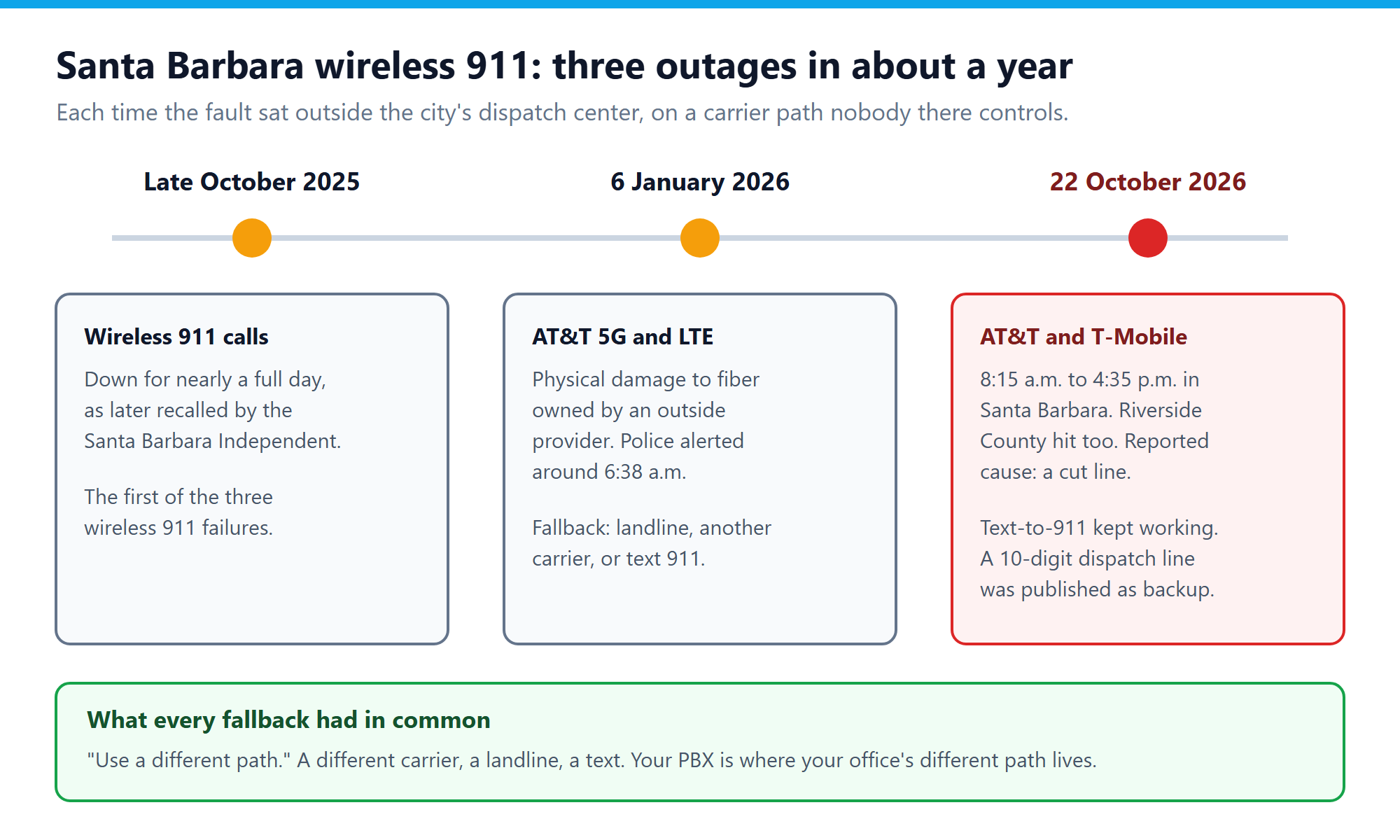
The city of Santa Barbara put out the alert that morning: 911 voice calls were failing for AT&T and T-Mobile customers. Callers were told to ring the police department’s 24/7 dispatch line on a 10-digit number instead, or to text 911, which kept working the whole time. Service came back at 4:35 p.m., according to the Santa Barbara Independent.
Santa Barbara wasn’t alone. Riverside County lost 911 for the same two carriers the same day, and Riverside City College police put it down to a cut line. AT&T pointed at damage to another provider’s fiber in the Los Angeles area, possibly linked to theft. Oakland had trouble too, but a different kind: its computer-aided dispatch system froze. That one sat inside the dispatch center, and no office phone system could have helped.
The pattern is what should bother you. In January the Independent described a 6 January AT&T outage, caused by physical damage to fiber owned by an outside provider, as the second such incident in months, after a late-October 2025 failure that took out wireless 911 for nearly a full day. Thursday makes three.
Every fallback said the same thing
Look at what officials told people each time. Use a landline. Use a phone on another carrier. Text instead. Call this 10-digit number. Every piece of advice comes down to one idea: take a different path to the dispatcher.
For an office, that different path is the phone system. Your desk phones don’t care which mobile network is down. They care which trunk your PBX sends 911 down, which carrier sits behind that trunk, and whether that carrier’s cable shares a trench with the one somebody just cut.
Most offices have never traced it. The 911 route was set up when the system went in, it worked on day one, and nobody has looked since.
Trace the call, one box at a time
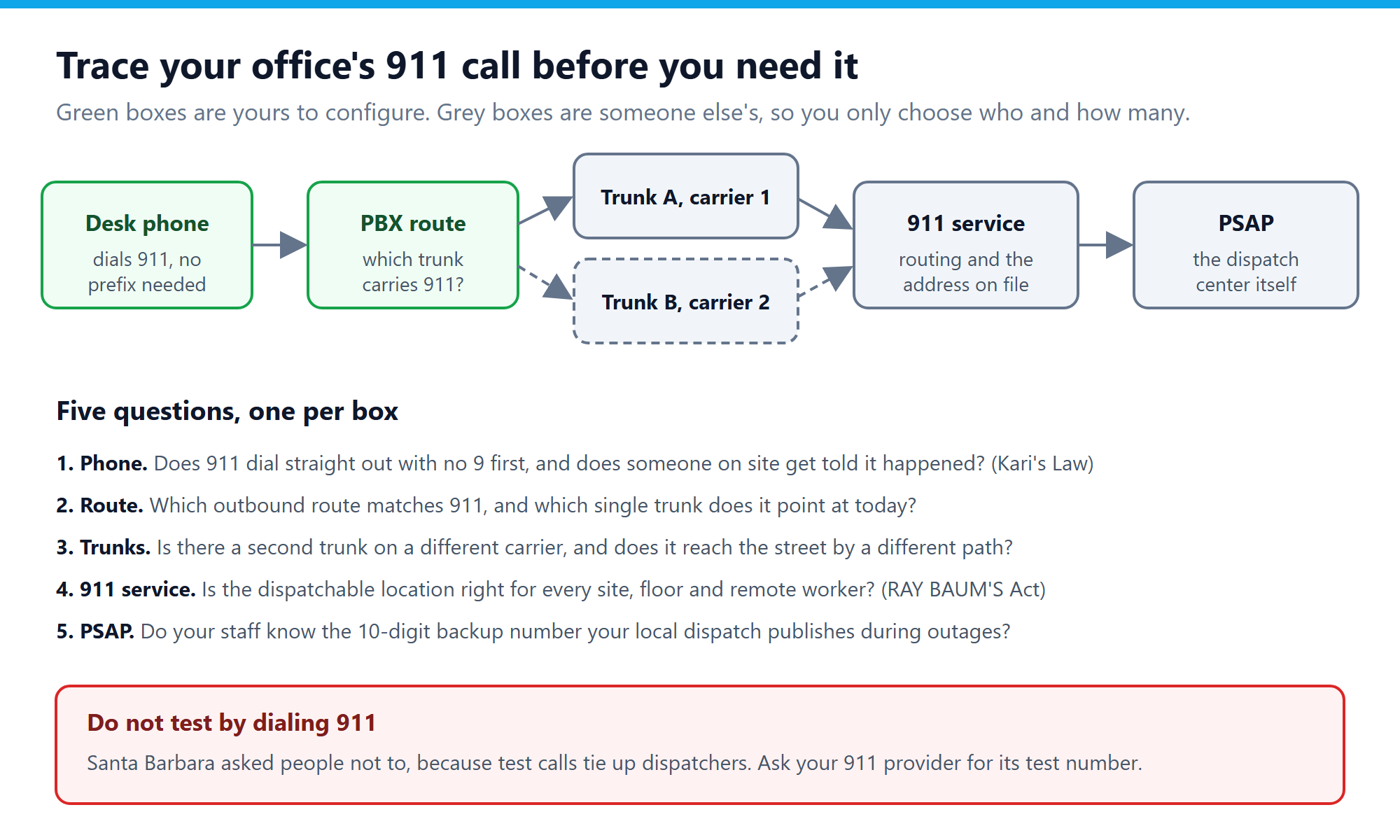
A 911 call from a desk phone passes through five places. You configure two of them. You only choose who runs the other three.
1. The phone
Under Kari’s Law, a multi-line telephone system has to let someone dial 911 directly, with no 9 or other prefix first. It also has to notify a central point on site, such as the front desk or security, when someone does, where that’s feasible without new hardware. Dial plans get edited over the years. Check that no change has quietly put a prefix back in front of 911.
2. The route
Open your outbound routes and find the one that matches 911. Note which trunk it points at. In ICTPBX, each outbound route covers one service, matches the destination patterns you give it, and sends calls through the provider you pick, so the answer is one screen away. If your 911 pattern sits inside a catch-all route that also carries long distance, give 911 a route of its own. Then you can repoint emergency calls without touching anything else.
3. The trunks
One trunk is one failure. A second trunk on a different carrier helps only if it really is different: different upstream network, and ideally a different physical way out of your building. Ask both providers how their traffic leaves your area. In ICTPBX the trunks list shows each provider’s registration status, so you can see straight away when one has dropped. Setting up a second provider is the same job as the first. Our SIP trunk setup guide walks through it.
4. The 911 service and the address on file
Section 506 of the RAY BAUM’S Act requires a dispatchable location to go with 911 calls from these systems. That means a street address plus the floor or suite a responder needs. The record usually lives with whoever provides your 911 service. It goes stale when people move desks, when a site opens, or when staff take softphones home. Ask your provider what address each extension or site is sending, and fix it before a dispatcher is relying on it.
5. The dispatch center
Both Santa Barbara and Riverside County published 10-digit numbers for people who couldn’t get through. Find out what your local dispatch center would publish, and put it somewhere staff will actually look during an outage: the intranet, a card at reception, the on-call runbook. Don’t wire it into the dial plan as an automatic 911 substitute. Those lines aren’t built for emergency call volume or location data, and that decision belongs to your local public safety agency, not your IT team.
Test without tying up dispatchers
On Thursday, Santa Barbara asked people not to call 911 just to see whether it worked, because every test call takes time away from real emergencies. The same goes for your PBX. Many 911 service providers offer a test number that reads back the location on file, often 933. Ask yours which number it supports, and use it after any dial plan or trunk change.
What this won’t fix
Be honest about the limits. If the dispatch center’s own systems fail, as Oakland’s did, nothing in your phone room helps. If both your carriers buy transport from the same backbone, a second trunk may share the very fiber that breaks. And if your 911 traffic and your provider’s 911 routing depend on the same regional network, diversity on your side only goes so far.
What you can do is make sure your office isn’t the weakest link in the chain. A single trunk, an old prefix in the dial plan and an address that still points at last year’s floor plan are all things you can fix this week. If you’re still running copper lines alongside the PBX, our piece on copper retirement covers what happens to those backup lines next. The ICTPBX feature list shows where routes, trunks and time conditions live.
FAQ
Did Thursday’s outage affect desk phones on VoIP?
The public notices described AT&T and T-Mobile mobile customers. Whether any office system was affected depends on which carrier and path carried its 911 traffic. That’s the point of tracing your own.
Is a second SIP trunk enough to protect 911?
It helps only if the second trunk takes a different network and physical route. Two providers reselling the same upstream carrier can fail together. Ask each provider how their traffic leaves your area before counting on it.
Can we automatically send 911 to the 10-digit dispatch number when the trunk is down?
Don’t do it on your own. Those administrative lines usually don’t carry caller location the way 911 does, and they aren’t staffed for emergency volume. Publish the number to staff, and take any routing decision to your local public safety agency.
What does Kari’s Law require from our phone system?
Direct dialing of 911 without a prefix, plus notification to a central location on site when a 911 call is placed, where that’s possible without improving the hardware or software. It applies to systems made, sold or installed after 16 February 2020.
Who keeps our dispatchable location up to date?
Usually your 911 service provider holds the record, but you’re the one who knows when people move. Treat it as a joint job, and check it whenever you open a site, change floors or send staff home with softphones.
How should we test 911 after a change?
Ask your 911 provider for its test number, often 933, which reads back the location on file without reaching a dispatcher. Never test by calling 911 itself.
Sources: City of Santa Barbara outage notices, 22 October 2026; Santa Barbara Independent, 22 October 2026 and 6 January 2026; NBC Palm Springs and Viewpoints (Riverside City College), 22 October 2026; Gizmodo, 23 October 2026.