
CVE-2026-116779 lets a single SIP MESSAGE run FreeSWITCH API commands, and it’s being exploited in the wild. New installs of ICTPBX, our PBX software, now ship with the path closed. If you already run an ICTPBX server, you can close it yourself in about ten minutes, or re-run the installer and let it do the work.
Below is what the bug actually does, what we changed, and the exact steps for a server that’s already in production. You don’t need to wait for a FreeSWITCH upgrade to be safe, and you shouldn’t.
What CVE-2026-116779 is
FreeSWITCH published the advisory, GHSA-mg63-h38w-8p9p, on 28 October 2026. NVD listed the CVE on 5 November with a CVSS score of 9.8, and CISA added it to its Known Exploited Vulnerabilities catalog on 9 November. Every FreeSWITCH release up to and including 1.11.2 is affected. The fix landed in 1.11.3.
The mechanism is almost embarrassingly simple. When a SIP MESSAGE arrives, the Sofia module splits the user part of the To header on a plus sign and treats the left half as the name of a chat protocol. One of the chat protocols FreeSWITCH registers, through mod_dptools, is called “api”, and it hands whatever follows straight to switch_api_execute(). So a message addressed to api+ isn’t delivered as chat at all. It runs as a command.
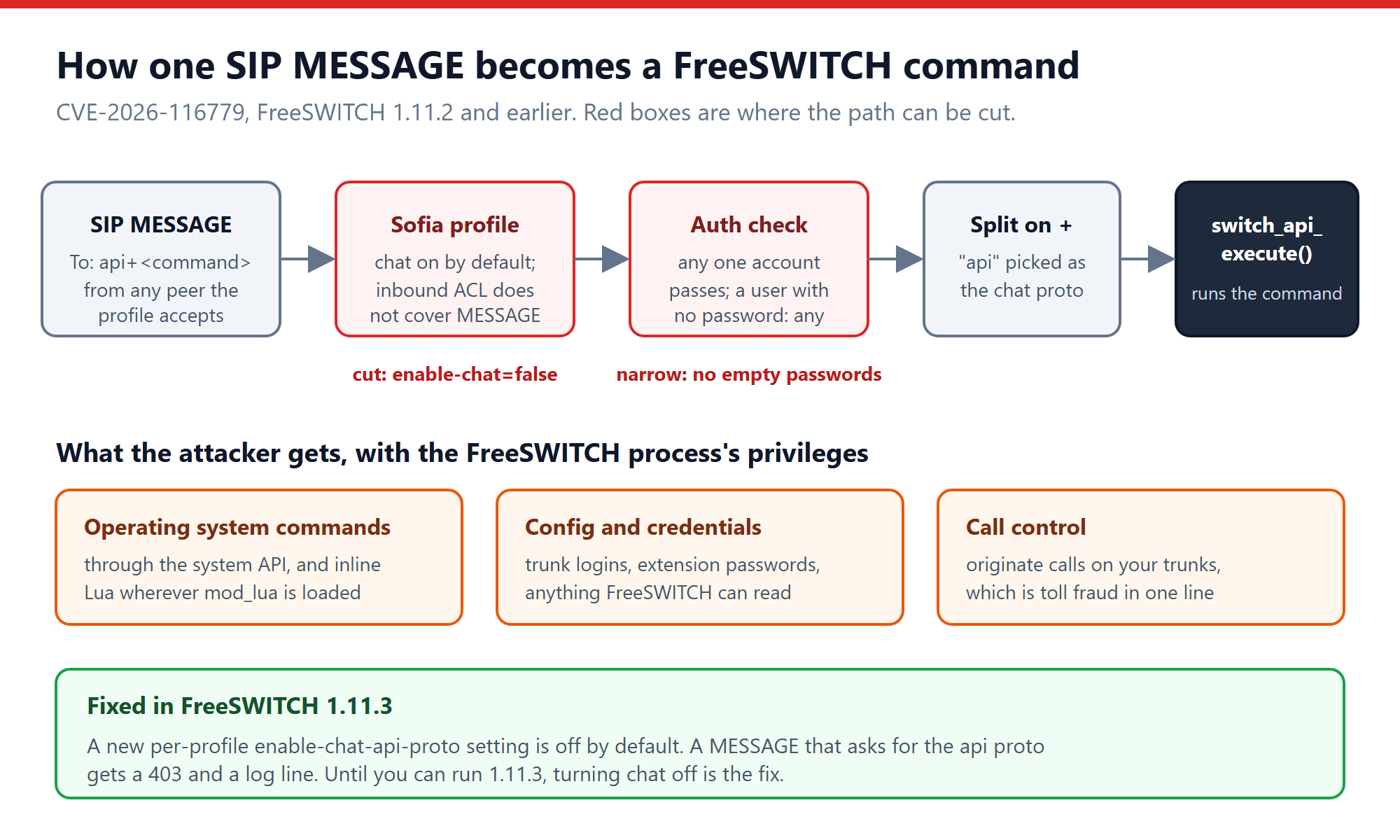
One accepted MESSAGE is enough. Turning chat off cuts the path at the profile, before the plus sign is ever parsed.
What runs, runs with the privileges of the FreeSWITCH process. That means operating system commands, a dump of configuration and stored credentials, and full call control, which on a PBX with live trunks is toll fraud waiting to happen. Where mod_lua is loaded, inline Lua is a second way in.
Why the usual PBX hardening doesn’t stop it
Here’s the part that should worry you. Chat is switched on by default in every SIP profile, and the inbound ACL that most admins lean on doesn’t apply to MESSAGE requests at all. Tightening your ACL won’t take a profile out of scope.
Authentication helps, but less than you’d hope. FreeSWITCH has required MESSAGE authentication by default since 1.10.7, which turns this into an authenticated attack. Any single account on the profile is enough, though: one extension, one desk phone, one trunk peer. Worse, a directory user that has neither a password nor an a1-hash authenticates with any password at all, unless allow-empty-password is set to false.
That last detail matters more on an IP PBX than people expect. Voicemail-only users, test accounts and stock example users often have no SIP password because nobody was ever meant to register them. For this bug, each one is an open door. If you’ve read our piece on PBX ports and network exposure, this is the same lesson from a different angle: the SIP port you leave open for phones is the port this attack uses.
What we changed in ICTPBX
We didn’t want to ship a single new install with this path open, so the hardening now lives in the installer for the free ICTPBX Community Edition, ictcore-ce-install.sh. On a fresh install it does three things:
- sets
enable-chat=falseon every SIP profile, the webrtc and ictcore profiles included; - sets
allow-empty-password=falsein every tenant domain, so voicemail-only directory users, which have no SIP password, can no longer be authenticated with any password (voicemail itself keeps working); - sets
disable_system_api_commands=trueas an extra layer.
The installer is safe to run twice. Run it again on an existing Community Edition server and it applies the same settings, then restarts the webrtc and ictcore profiles so they take effect. The hosted ICTPBX platform we run for Enterprise customers has the same changes applied.
Why configuration rather than an upgrade? Because packaged FreeSWITCH 1.11.3 isn’t available yet in the repositories ICTPBX installs from, which currently stop at 1.10.12 and 1.11.1. We’d rather close the path today with a setting than wait. The configuration fix stays in place until 1.11.3 packages exist, and it’s harmless to keep afterwards unless you genuinely need SIP chat. For a refresher on how ICTCore and FreeSWITCH fit together in the stack, see the FreeSWITCH configuration guide.
How to close it on an existing PBX software server
If you installed ICTPBX before this week, or you run FreeSWITCH under any other PBX software, these are the steps. Do them in a quiet window, because restarting a profile drops the calls on it.
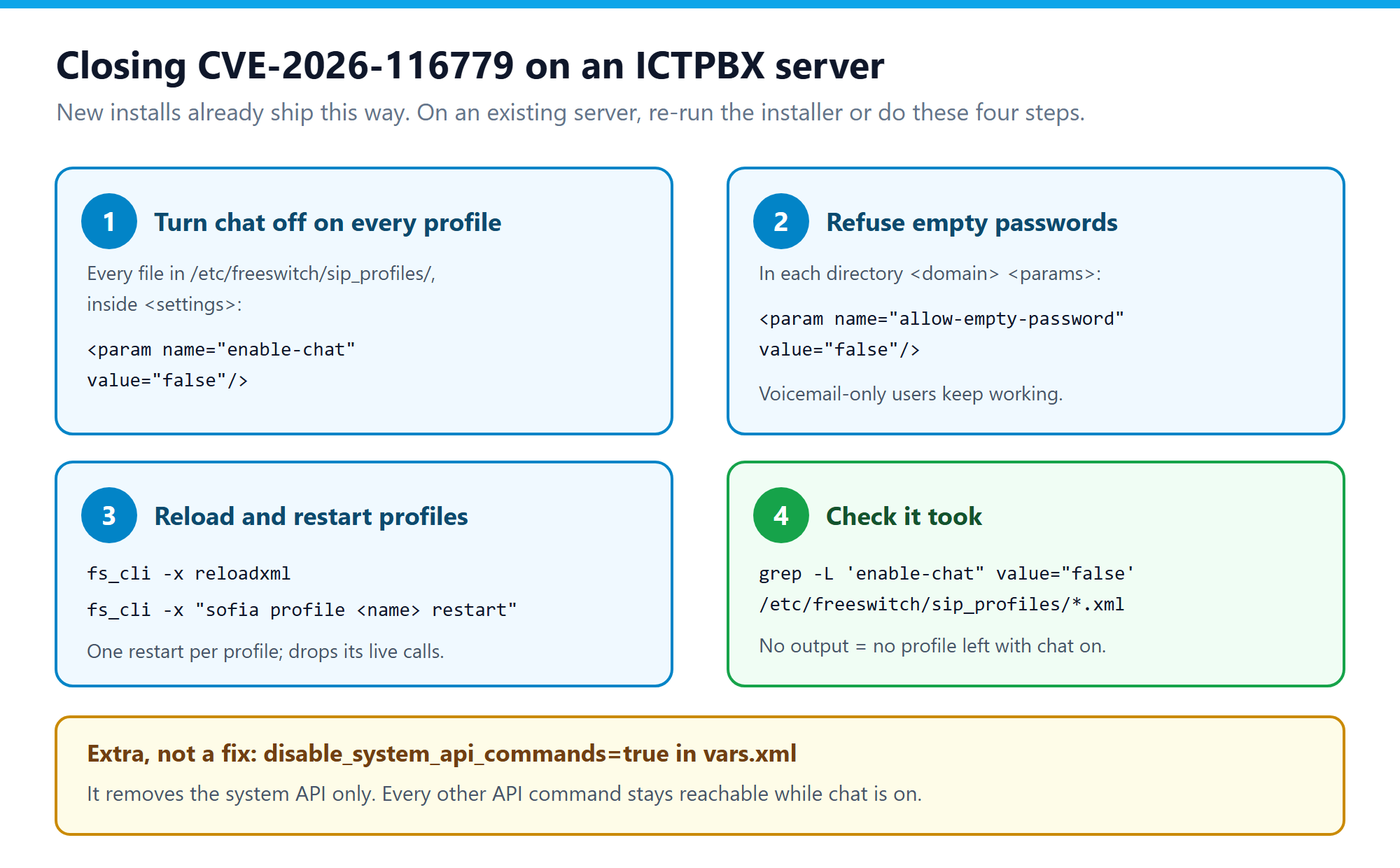
Steps 1 and 3 close the path. Step 2 shrinks who could reach it if chat is ever turned back on.
1. Turn chat off on every profile. Open each file in /etc/freeswitch/sip_profiles/ and add this line inside its
Don’t skip the profiles you think are internal only. The webrtc profile and any extra profile you’ve added for a carrier count too.
2. Refuse empty passwords. In the
While you’re there, delete any stock example users you don’t use. They tend to survive installs for years.
3. Reload and restart. Reload the XML, then restart each SIP profile by name. fs_cli -x "sofia status" lists them if you aren’t sure what you have.
fs_cli -x reloadxml
fs_cli -x "sofia profile internal restart"
fs_cli -x "sofia profile webrtc restart"
Swap in your own profile names and repeat the restart line for each one.
4. Check it took. This command prints any profile file that still doesn’t have chat turned off. No output is what you want.
grep -L 'name="enable-chat" value="false"' /etc/freeswitch/sip_profiles/*.xmlThen confirm each profile came back up and is running with fs_cli -x "sofia xmlstatus profile . If one fails to start after the restart, look for a typo in the line you just added before anything else.
You can also set disable_system_api_commands=true in vars.xml. Treat it as defence in depth, not a fix. It removes the system API, but every other API command, including module loading and call origination, stays reachable while chat is on.
When FreeSWITCH 1.11.3 reaches your repo
Upgrade when the packages exist. The 1.11.3 fix adds a per-profile enable-chat-api-proto setting that’s off by default, so a MESSAGE that tries to pick the api protocol gets a 403 and a log line with its source and the command it asked for. That’s the proper fix, and the log is useful too.
Our honest view is that most PBX deployments should keep enable-chat=false even after upgrading. Very few business phone systems use SIP MESSAGE for anything, and a feature nobody uses is just attack surface. If you do rely on SIP chat, turn it back on only after 1.11.3 is running and the api proto is confirmed off. If you need help with a hosted PBX or a self-managed install, our installation guide covers where each piece lives.
FAQ
Is my ICTPBX server affected by CVE-2026-116779?
If it runs FreeSWITCH 1.11.2 or earlier with chat enabled on any SIP profile, yes. Community Edition installs made with the current installer already have chat off. Older installs need the steps above or a fresh run of the installer.
Do hosted ICTPBX customers need to do anything?
No. The hosted ICTPBX platform we run for Enterprise customers already has chat off on every profile and empty passwords refused.
Will turning off SIP chat break anything on my IP PBX?
It stops inbound SIP MESSAGE chat delivery on that profile. Calls, voicemail, fax and the rest of the PBX keep working. Most business deployments never used SIP chat in the first place.
Is MESSAGE authentication enough on its own?
No. It limits the attack to someone holding a valid account, but any single extension or trunk peer qualifies, and users with no password accept any password unless you set allow-empty-password to false.
Does disable_system_api_commands fix the bug?
No. It removes one API command. The route from a SIP MESSAGE to the API is still there, and other commands, including call origination, remain reachable.
Should I still upgrade to FreeSWITCH 1.11.3?
Yes, once packages are available in your repository. Keep chat off after the upgrade unless you actually need it.
Related Resources
- Toll fraud and SIP security for your PBX
- Multi-tenant PBX security best practices
- ICTPBX hosted PBX solution
- Open source PBX software guide
Sources: FreeSWITCH security advisory GHSA-mg63-h38w-8p9p (signalwire/freeswitch, 28 October 2026); NVD entry for CVE-2026-116779 (published 5 November 2026); CISA Known Exploited Vulnerabilities catalog (added 9 November 2026).