
The FCC adopted FCC 26-67 on 30 September 2026, and buried in it is something operators have asked for since 2024: you can now name one way to opt out and refuse to process requests made any other way. It is a real reduction in burden. It also quietly assumes your platform can do several things it probably cannot do today.
What you are allowed to designate
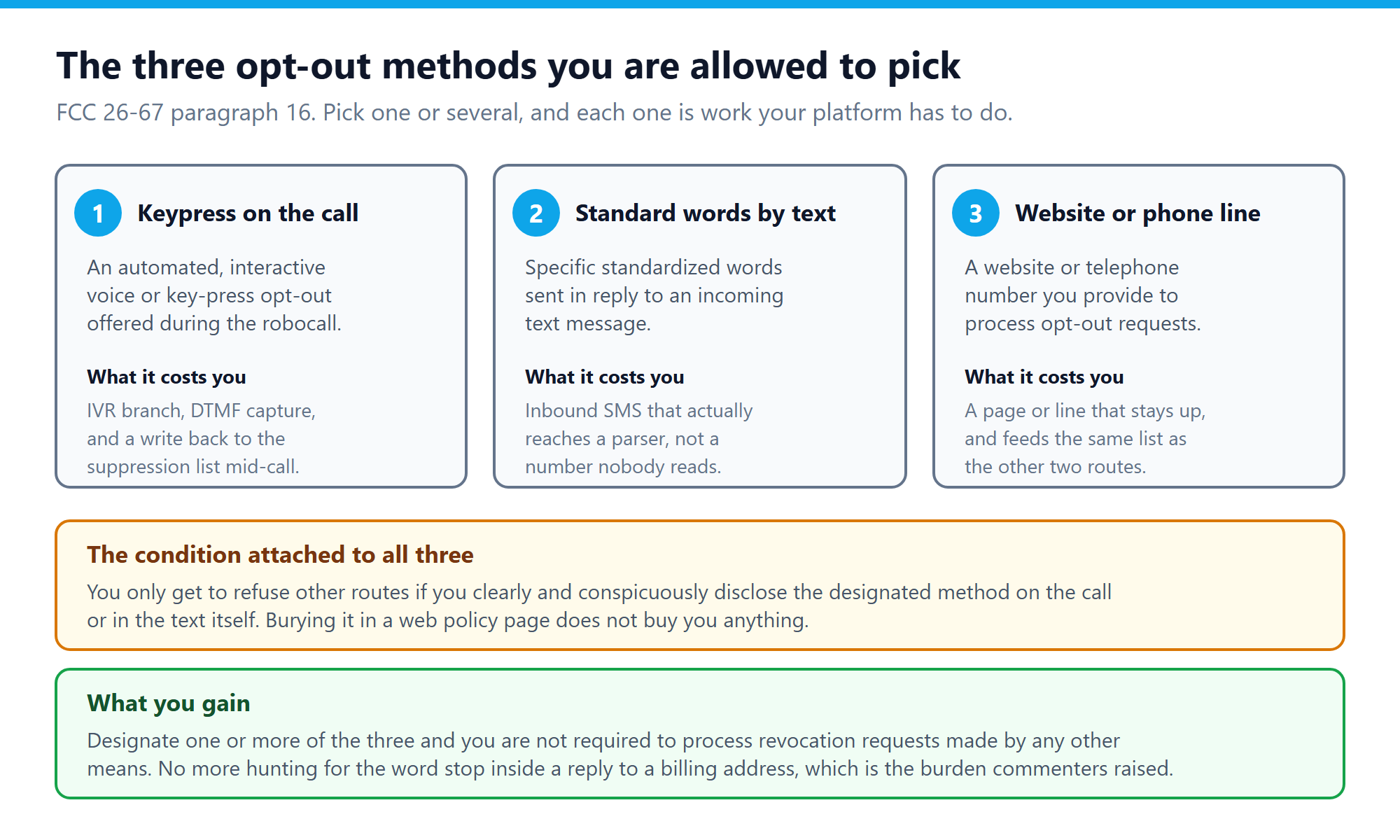
Paragraph 16 of the Order is the operative text. Callers may designate an exclusive revocation method that requires one of three things, or several of them together.
First, an automated, interactive voice or key-press activated opt-out mechanism offered in response to a robocall. Second, specific standardized words sent in reply to an incoming text. Third, a website or telephone number you provide to process opt-out requests.
Pick one or more of those and, in the Commission’s words, you are not required to process revocation requests made by any other means. That is the whole prize. No more scanning a free-text reply about a billing address for a buried instruction to stop calling.
The condition most summaries skip
You only get that protection if you clearly and conspicuously disclose the designated method on the call or in the text itself.
On the call, or in the text. Not on a web page somebody could in principle find. If your opt-out instruction lives only in a terms document, you have not designated anything and you are still on the hook for honouring any reasonable method.
For a voice channel that means the disclosure has to be in the audio. For SMS it has to be in the message body, which costs you characters on every single send. Neither is hard. Both need deciding before you turn this on.
Why this is a platform problem, not a policy one
Designating a method is a sentence in a script. Running it is a path through your own system, and that path has four steps where most setups break at step two.
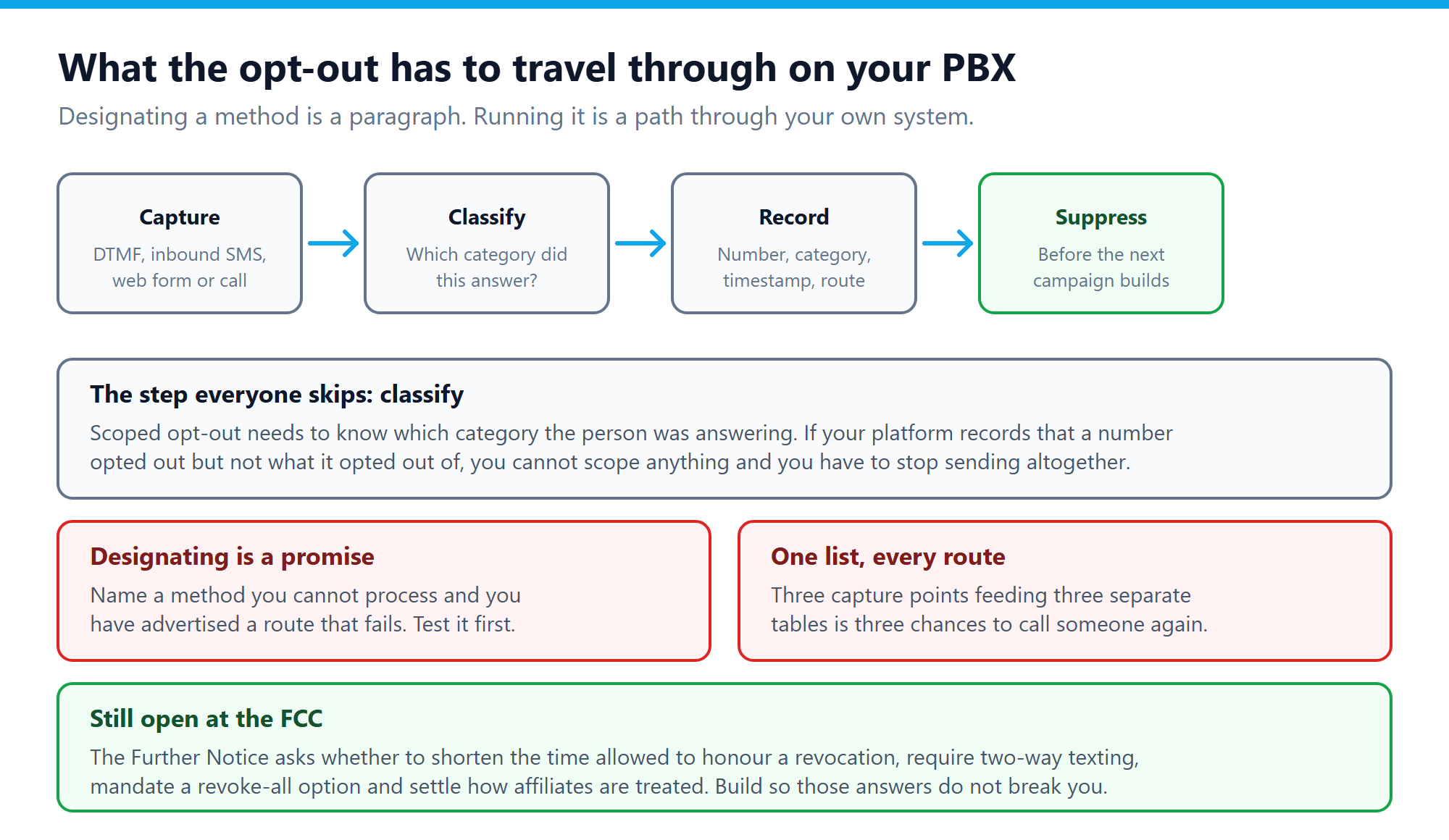
Capture is the obvious one. A DTMF press mid-call, an inbound SMS, a web form, a phone line. Most platforms handle at least one of these.
Classify is where it falls apart. The same Order lets you treat an opt-out against an informational message as covering only that category rather than everything you send. That only works if you record what the person was answering. Plenty of systems write down that a number opted out and nothing else. If that is all you have, you cannot scope anything, and the safe reading is that they opted out of the lot.
Record means number, category, timestamp and which route it arrived on. Suppress means the list is consulted when the next campaign is built, not after it has gone out.
Two failure modes worth naming
Designating a method you cannot actually process is the worse one. If you announce a keypress opt-out, the keypress has to reach something that writes to the suppression list during the call. Announcing a route that silently fails is worse than not designating at all, because you have told every recipient that this is the way and then ignored them.
The second is subtler. If you designate two or three methods, they must feed one list. Three capture points writing to three tables is three chances to call somebody who already told you not to. We have written before about sending SMS directly from PBX software, and this is the part that turns a messaging feature into a compliance surface: inbound has to be as well plumbed as outbound.
Test before you announce
My recommendation is blunt. Before you put a single disclosure into a script, run each designated route end to end on your own numbers and confirm the suppression list actually changed. Then run a campaign against a list containing that number and confirm it was skipped.
That is an afternoon of work and it is the difference between a defensible position and a documented failure. The Commission has made the burden lighter, not lighter and optional.
The same instinct applies to tenant-level controls generally. Verifying what each tenant is allowed to do before a call goes out is the pattern behind the FCC know-your-customer expectations for multi-tenant platforms, and an opt-out register is the same shape of problem: per-tenant state that has to be right at dial time.
What is still unsettled
The Further Notice attached to the Order asks whether to shorten the window for honouring a revocation, whether to require two-way texting functionality, whether to mandate a revoke-all option alongside whatever you designate, and how affiliates should be handled. Those questions came from a joint filing by the American Bankers Association, the National Consumer Law Center and ACA International.
Comments are due 30 days after Federal Register publication, replies at 60. A mandated revoke-all option would be the one to watch, since it cuts across the exclusive-method design you are about to build. Build so that adding a fourth route later is a configuration change rather than a rewrite.
When it starts
The amendments take effect 30 days after Federal Register publication, which had not happened when this was written. At that point the change supersedes the delayed effective date previously extended to 31 January 2027. If your roadmap has this work parked against a January 2027 date, move it forward.
FAQ
Can we designate a method and still accept others?
Yes. The Order removes the requirement to process other routes, it does not forbid you from doing so. Accepting more is always safe. Accepting fewer than you advertised is not.
Does a keypress opt-out have to work on every call?
If that is the method you designated and disclosed, it has to work when you offer it. Note also that paragraph 19 leaves the existing requirement in 64.1200(b)(3) intact for exempted calls and for anything carrying an advertisement, so some calls already needed an interactive opt-out regardless.
What standardized words count for the SMS route?
The Commission had already adopted a standardized list in the 2024 order so automated systems could recognise common opt-out words. Your parser should match that list rather than an invented one.
Does this apply to calls that are not robocalls?
The Order defines a robocall as a call made or text sent using an automatic telephone dialing system or an artificial or prerecorded voice. A live agent dialling manually sits outside that definition, though other rules may still apply.
How long do we have to action a revocation?
The existing timeframe stands for now. The Further Notice asks whether to shorten it, so treat any build that only just meets the current window as fragile.
We are a multi-tenant platform. Whose obligation is this?
The caller’s. In practice your tenants are the callers and you are the system they rely on, so the realistic answer is that you have to give them per-tenant designation, per-tenant disclosure and a per-tenant suppression list that is not shared across tenants.
Source: Federal Communications Commission, FCC 26-67, Report and Order and Further Notice of Proposed Rulemaking, CG Docket No. 02-278, adopted 30 September 2026, released 1 October 2026.